
Debiased (Neyman-orthogonalized) score tests for assessing whether a semiparametric or parametric regression model is well-specified and for comparing nested models.
The test uses a hunt-and-test strategy with sample splitting: on a
held-out hunt sample, it fits the null model and uses machine
learning to find a direction in which the null model’s score seems
positive; on an independent test sample, it assesses the
significance of the score in the hunted direction. The test employs
orthogonalization to eliminate the plug-in bias from estimating the null
model, yielding a test statistic that is asymptotically standard normal
under the null without requiring a parametric form for the alternative.
Methods are provided for glm, lm, and
mgcv::gam fits as well as for detecting heterogeneous
treatment effects.
You can install the package from CRAN with
install.packages("dScoreTest")or the development version from GitHub with
# install.packages("remotes")
remotes::install_github("richardkwo/dScoreTest")Two entry points, both S3 generics that dispatch on the fitted model:
gof_test() — is a fitted model well-specified, against
a nonparametric alternative?compare_models() — does a nested alternative capture
signal that the null model misses?library(dScoreTest)
library(mgcv)
set.seed(42)
dat <- gamSim(eg = 1, n = 400, dist = "normal", scale = 2, verbose = FALSE)We simulate from the four-term additive truth in
mgcv::gamSim(eg = 1),
y = f0(x0) + f1(x1) + f2(x2) + f3(x3) + noise, where
f3 = 0 and f0, f1, f2 are non-linear.
gof_test() checks the functional form of a fitted model
against a nonparametric alternative. A well-specified non-linear
additive model is not rejected, while forcing the model to be linear
is.
fit.gam <- gam(y ~ s(x0) + s(x1) + s(x2) + s(x3), data = dat)
gof_test(fit.gam)   # well-specified: not rejected
#> Debiased score test:
#> y ~ X, with X consists of x0, x1, x2, x3.
#> (hunt.style = optimal, hunt.method = grf, debias.method = standard)
#> n = 400, two-way split: hunt = 200, debias & test = 200
#>
#> T = 0.6274, p-value = 0.265214

fit.lm <- lm(y ~ x0 + x1 + x2 + x3, data = dat)
gof_test(fit.lm)   # misspecified:
#> Debiased score test:
#> y ~ X, with X consists of (Intercept), x0, x1, x2, x3.
#> (hunt.style = optimal, hunt.method = grf, debias.method = standard)
#> n = 400, two-way split: hunt = 200, debias & test = 200
#>
#> T = 9.7238, p-value = 1.19302e-22
Note that gof_test only sees the covariates in the
model’s formula, so it tests whether E[y | covariates] has
the assumed form, not whether covariates are missing.
compare_models() tests a null model against a nested
alternative, and detects signal living in the alternative’s extra terms.
Here the null drops s(x2) (a real, sharp effect), while the
alternative includes it.
# null model: well-specified since f3 = 0 in DGM
fit.gam.null <- gam(y ~ s(x0) + s(x1) + s(x2), data = dat)
compare_models(fit.gam.null, fit.gam)
#> Debiased score test:
#> y ~ X, with X consists of x0, x1, x2, x3.
#> (hunt.style = optimal, hunt.method = gam, debias.method = standard)
#> n = 400, two-way split: hunt = 200, debias & test = 200
#>
#> T = 0.9375, p-value = 0.174243

# null model: misspecified, missing f2
fit.gam.mis <- gam(y ~ s(x0) + s(x1), data = dat)
res <- compare_models(fit.gam.mis, fit.gam)
res
#> Debiased score test:
#> y ~ X, with X consists of x0, x1, x2, x3.
#> (hunt.style = optimal, hunt.method = gam, debias.method = standard)
#> n = 400, two-way split: hunt = 200, debias & test = 200
#>
#> T = 9.5337, p-value = 7.58703e-22
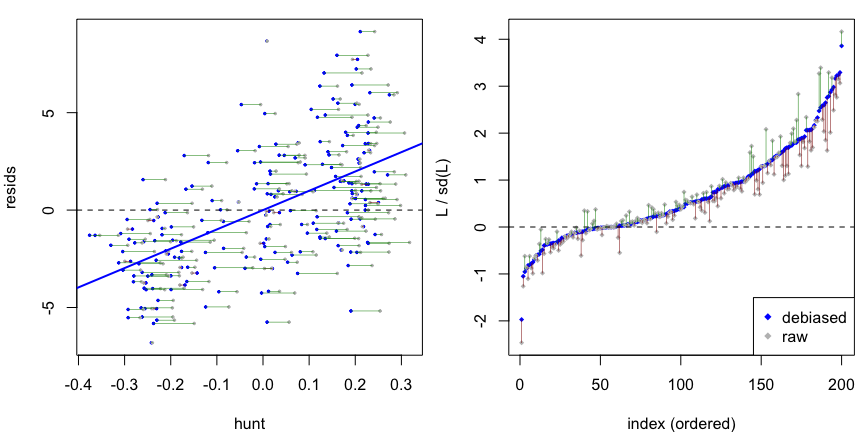
Both functions return a dScoreTest object with
print(), summary(), and plot()
methods. The hunt for a direction of misspecification can use the
optimal (hunt.style = "optimal", default),
weighted-least-squares ("wls"), or vanilla
("vanilla") algorithm.
plot(res)
The methodology is described in:
Dhawan, A., Guo, F. R. and Shah, R. D. (2026). The debiased score test: hunt-and-test for semiparametric hypotheses. arXiv:2607.28861. https://arxiv.org/abs/2607.28861
citation("dScoreTest")